
Casselberry Directory Collections by Era
Casselberry's city-directory trail belongs to a wider Orlando and Seminole County shelf. No official catalog publishes a complete Casselberry-only year run. Search each volume rather than assuming its cover title includes or excludes the city.
| Collection | Verified years or scope | Where held | Access |
|---|---|---|---|
| Florida city directories | Early 1900s to present statewide holdings | State Library of Florida | On-site reference and catalog help |
| R.L. Polk Orlando directory | 1940-1963 cataloged run; later title from 1975 | WorldCat holding libraries and state catalog | Check each volume for suburban coverage |
| Orlando-area telephone books | Runs from 1935-1949, 1955-1956, and 1960-1961 | Library of Congress | Free online browsing |
| Genealogy databases and microfilm | Reported Orlando Sentinel 1966-1995 plus licensed databases | Jean Rhein Central Branch | Library computers, some remote access; confirm license |
| Local history | Casselberry-specific photos, stories, and referrals | Society for Historic Casselberry | Contact the society |
| Population schedules | Public federal census through 1950 | National Archives and access partners | Online or library access |
Gaps are part of the evidence. Rural routes, unlisted phones, publication limits, and annexation may exclude a person or an entire area from one issue.
WorldCat and a library catalog describe a title and its holdings, not every community printed inside. R.L. Polk's cataloged 1940-1963 Orlando run mentions Winter Park and Orange County taxpayers, but Casselberry coverage must still be checked page by page. Later Polk Orlando titles begin in the catalog from 1975. A suburban cross-reference book may contain Casselberry even when the place is missing from the cover, while an Orlando title may stop short of the city.
Find Casselberry Under Older Labels
Early searches should rotate through Casselberry, Fern Park, Lake Concord, Fern Park Estates, Winter Park Ferneries, Maitland, and Orlando. The town incorporated in 1940, became a city in 1965, and gained its own named post office in 1959. Postal and civic names did not change at the same time.
This explains why a Casselberry city directory may have an Orlando title. A 1930 Orlando telephone book even shows founder Hibbard Casselberry with a residence notation and Maitland Drive. The entry predates a mature city heading and shows why searching a person's name can work better than browsing only a place section.
Decode a Casselberry Directory Entry
An alphabetical entry commonly gives a surname, given name or initial, spouse, trade or employer, and residence. Publisher codes vary. Photograph or transcribe the abbreviation key before interpreting a mark.
| Name | Listed subscriber, sometimes with a spouse in parentheses |
|---|---|
| Trade or employer | The occupation line may separate two people with the same name |
| Residence | House number and street, often preceded by “r” |
| Householder mark | Some issues distinguish a householder or owner, but conventions vary |
| Widow notation | “wid” followed by a spouse's name can guide an obituary or death search |
| Telephone | Subscriber number and exchange in telephone books |
- Criss-cross directory
- An address-first section that returns a listed subscriber.
- Householder index
- A list organized around the person or party shown as responsible for a home.
- Abbreviation key
- The publisher's legend for residence, spouse, widow, trade, and other shortened terms.
A city directory entry is selective publication data. It does not list every child, relative, roommate, or person without a telephone.
Casselberry's Local Library Starting Point
The Jean Rhein Central Branch at 215 North Oxford Road is the closest in-person bridge to countywide historical sources. Reported resources include Orlando Sentinel microfilm, genealogy databases, obituary tools, and staff help. The official branch hours are Monday through Thursday, 9 a.m. to 8 p.m.; Friday and Saturday, 9 a.m. to 5 p.m.; and Sunday, 1 to 5 p.m.
Ask for reverse directories, suburban telephone books, newspaper databases, and catalog records that use Fern Park or Orlando. Confirm current database licenses before making a trip. Some tools may work from home with a library card, while others are restricted to library computers.
Statewide Shelves for Casselberry Directories
The State Library of Florida's Florida Collection holds city directories from the early 1900s to the present. They are arranged by city and then year for on-site reference use. Call the Reference Desk at 850-245-6682 and ask staff to check Casselberry, Fern Park, Seminole County, and Orlando catalog headings.
The State Library city directory holdings page is pictured below.
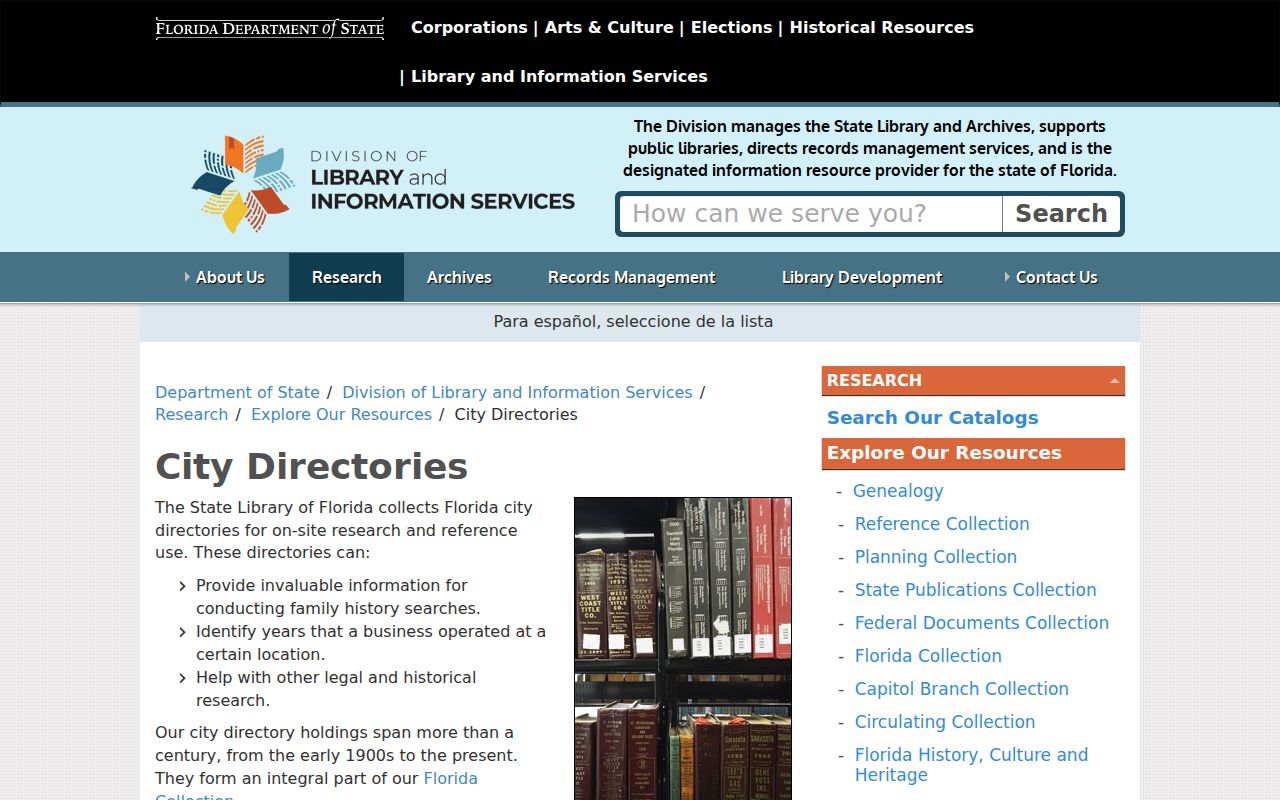
The catalog identifies the shelf, but only inspection of a volume can confirm whether Casselberry appears in its coverage area.
Casselberry Genealogy Beyond Directories
The State Archives offers government records, manuscripts, a genealogy bibliography, and catalog help. These sources can explain a city directory change through a marriage, death, estate, land transfer, or public role.
The official Florida genealogy collection is shown below.
Use its catalog citation with the directory year, page, and repository so another researcher can reproduce the match.
Casselberry History Adds Local Context
The Society for Historic Casselberry, founded in 2021, focuses on local preservation, photographs, stories, and referrals. Its material may identify an institution, fernery, church, subdivision, or event that makes a thin directory entry understandable.
The Society for Historic Casselberry site is pictured below.
Local memory is a lead, not a substitute for the printed entry, census page, deed, or vital record used to verify it.
Trace Casselberry Families by Directory
Follow one household through the available city directories, then pair each listing with a source created for another purpose. The newest public federal population schedule is the 1950 census under the 72-year rule.
- Start in the issue nearest a known event and copy the full entry, including initials, spouse, trade, address, and phone.
- Move backward one available issue at a time. Record each change without assuming its cause.
- Use the reverse section to confirm the road and nearby listed subscribers.
- Pair the run with the 1950 or earlier census to test age, birthplace, relationship, and occupation.
- Use marriage, death, obituary, probate, cemetery, or deed records to explain a disappearance or name change.
A missing listing can mean a move, death, unlisted phone, rural route, or coverage gap. Check the next available issue before drawing a conclusion.
Workers and tenants can be especially hard to see in owner rolls. Casselberry's historical narrative notes that African-American fernery workers lived around Evergreen Cemetery and nearby areas. Census households, church or cemetery records, and newspapers may recover people whom deed indexes miss. Treat memorial information as a lead and pair it with a census page, obituary, probate file, or vital record. This broader method keeps family history from favoring only the people who held title to land.
Cite Every Casselberry Directory Find
Save the title, publisher, year, page, column, repository, and image or call number. Also record the exact spelling, abbreviations, and place label. A citation turns a promising name into a result someone else can inspect.
For current address-keyed records, shift to the Casselberry street directory. Historical volumes should stay in their own role: dated snapshots that can bridge census years and guide later checks.
If a scan is hard to read, note the page and ask the holding library about a clearer copy or another edition. Compare nearby names and addresses before correcting a spelling. Printing quirks and initials can create false matches, so preserve the original text beside any modern interpretation.